

School Social Work in Saxony-Anhalt faces an uncertain future. Funding for many positions through EU funds will expire in mid-2028. A decision is actually needed now. This is the only way to finance school social work long-term and retain personnel. However, the state and municipalities are blaming each other for the predicament. You can find out here about the challenges faced by school social workers, what the end of school social work would mean for Neustadt, and what must be done instead to save it.
Jenny Janko starts her workday every morning with a to-do list. But no matter what she plans, things always turn out differently. Janko has been a school social worker in Halle-Neustadt at the Kastanienallee primary school for ten years. Janko loves her job; it is diverse, offers a lot of freedom and flexible working hours. She would like to dedicate more time to activities in the school garden or organise art projects, but there is not enough time for that.
The majority of her tasks consist of acute crisis interventions, which means that students refuse to attend lessons or disrupt them to the extent that they become impossible. This means talking to the children and listening to find out what the problem is. These are often everyday problems, such as arguments between friends. Things that have no value for adults but take up a lot of space in the children’s lives. Having trusted people to whom the children can confide is important. School social workers are the social glue that holds the school together. Janko benefits from the fact that she knows all the children by name, and often their parents and siblings too. School social work is relationship work – and that takes time.
“Language is one of our biggest hurdles”
If the conversation goes well, the child can return to class; if not, the parents must be called. Janko also has to deal with them. For example, when they – often in a quick, unplanned way – want to discuss applications for the Jobcenter with Janko unannounced. Almost all children at the school live in households that depend on social benefits. However, this is not the greatest challenge.
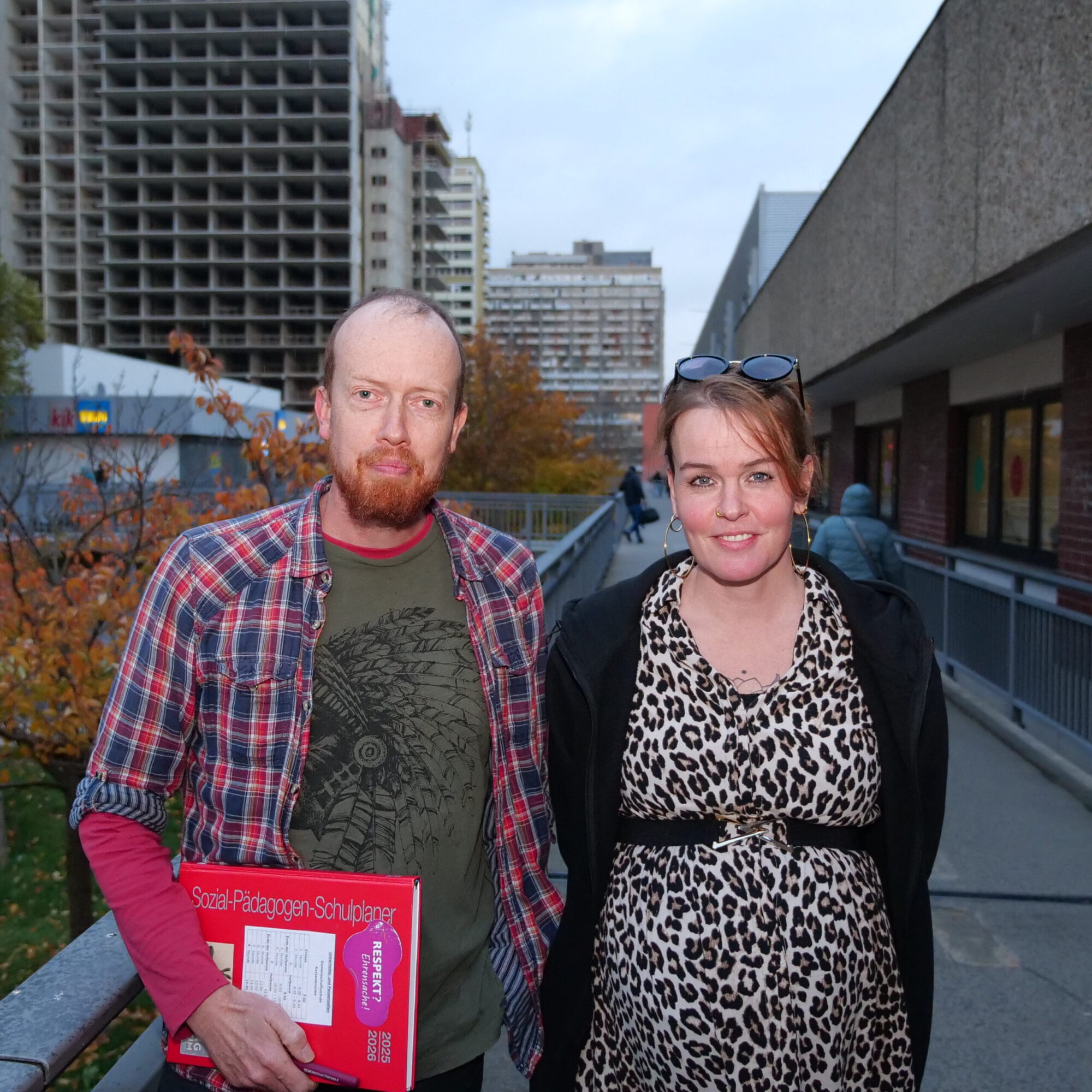
Jan Metzner and Jenny Janko work as school social workers in Halle-Neustadt and tell us about the challenges they face in their everyday school life
“Language is one of our biggest hurdles,” says Janko. When she started her job ten years ago, the proportion of migrants at the school was 30 percent, but now it is 86 percent. Children from 29 nations learn together here. Of the 358 children at the school, almost a third have special educational needs, meaning they exhibit behavioural problems, suffer from autism or ADHD. Many also have a reading and writing weakness or difficulties solving the simplest math problems. This requires special support and supervision.
Children who could be well placed in special needs schools are also taught inclusively at Kastanienallee primary school. This is also because the special needs schools lack the corresponding capacities. In addition, many students are undiagnosed because children must have attended school in Germany for one year before a diagnosis is approved. Whether the children even bring school readiness when they start school is irrelevant. This is another reason why language acquisition should have absolute priority in the first grade. “But we also need lessons that are designed to specifically promote bilingualism,” says Janko.
Furthermore, the children often come from broken families. Many siblings, little space, no private room or a quiet place to work to do homework – this means continuous stress for the children. Added to this are the traumas that many students have experienced: flight, displacement, violence, or the loss of relatives. Janko believes that more school psychological support and better connections to child psychological practices are needed to process these experiences.
One in two is thinking about changing jobs
Janko appreciates the variety in her job; no day is like the other. But Janko is unsure whether she will continue the work forever. “After over 10 years, nothing can shock me anymore.” And that’s true even when mothers are housed in women’s shelters or students are taken into custody by the police. Individual cases that are not everyday occurrences but occupy Janko even after work. What helps Janko is the solidarity among colleagues and the support of her family.
Nationwide, almost one in two school social workers is considering changing jobs, according to a study by HTW Saar, whose preliminary results were first reported by the research platform Correctiv. The reasons for the possible career change: emotional stress, lack of appreciation, and working in isolation.
Janko can consider herself lucky to have another school social worker on the team. In Halle-Neustadt, almost every school has two full-time positions. In fact, every school in Halle should have at least one school social worker, but the fact that this is not the case is due to the city’s distribution key. School-related factors are used for this, such as the proportion of students with special educational needs or those who have failed to be promoted. The surrounding environment also plays a role: such as the proportion of young people, single parents, or people with a migration background in a district. Ongoing youth welfare measures, such as educational assistance from the youth welfare office, are also considered, and the receipt of citizen’s benefit (Bürgergeld) in a district is also included in the calculation. It turns out that the needs in Halle-Neustadt are the highest.
Many students from the Kastanienallee primary school transfer to the neighbouring comprehensive school in the fifth grade, with which they share a playground. Janko’s colleague Jan Metzner works here as a school social worker.
When students enter puberty, they no longer put up with everything. They become more self-confident, some disregard authority, and skip class. Some students, however, are underchallenged and then disrupt lessons, partly because they come from families with low educational backgrounds, where school success is not highly valued. “If these students came from the educated middle class, they would be in grammar school. That means they don’t really have to do anything to stay in our school and can just mess around,” says Metzner. The only thing that helps is clear and understandable communication and an open and appreciative approach. Recommendations that Metzner also suggests to the teachers. “Our students are very pragmatic. If they realise that they will never need the subject matter again, they ignore it. What motivates them is that they trust the teacher that this is important now. The students react extremely to the fact that you want to accept them, that you want them in the school, in the class, that you are happy to have them as students.”
The HTW Saar study also showed that nationwide, Saxony-Anhalt is at the bottom when it comes to making employment contracts permanent. This is because the majority of the funding for school social work in Saxony-Anhalt is project-related and comes from the European Social Fund (ESF). 50 positions in Halle (Saale) are financed this way, including those of Janko and Metzner. However, the financing of school social work through ESF funds is on the brink. The current funding period expires on July 31, 2028. What happens after that is uncertain.
Nevertheless, the funds are already insufficient to meet the staffing needs. In Halle (Saale), the city additionally finances twelve positions with 40 percent of the costs. Almost 13 positions are exclusively financed by municipal funds. All school social workers in the city are employed by independent organisations. Although Janko has an unlimited employment contract, it is uncertain whether the organisation will pay for staff for whom there are no positions – operational layoffs are threatening, even though school social workers are desperately sought after in many places and many positions remain vacant.
Therefore, professional associations, trade unions, and municipalities have been calling on the state for years to ensure planning security for school social workers and their organisations – also to counteract the fluctuation of skilled workers. As was recently the case at the end of October in the Halle (Saale) city council: in a cross-party resolution, the city councillors called on the state to ensure secure funding for school social work through state funds and to enshrine school social work in state law. The resolution was adopted unanimously, with abstentions from the CDU and AfD factions. A few years ago, school social work was first clearly enshrined in the Sozialgesetzbuch. The details are determined by state law, but a corresponding regulation is still missing in Saxony-Anhalt.
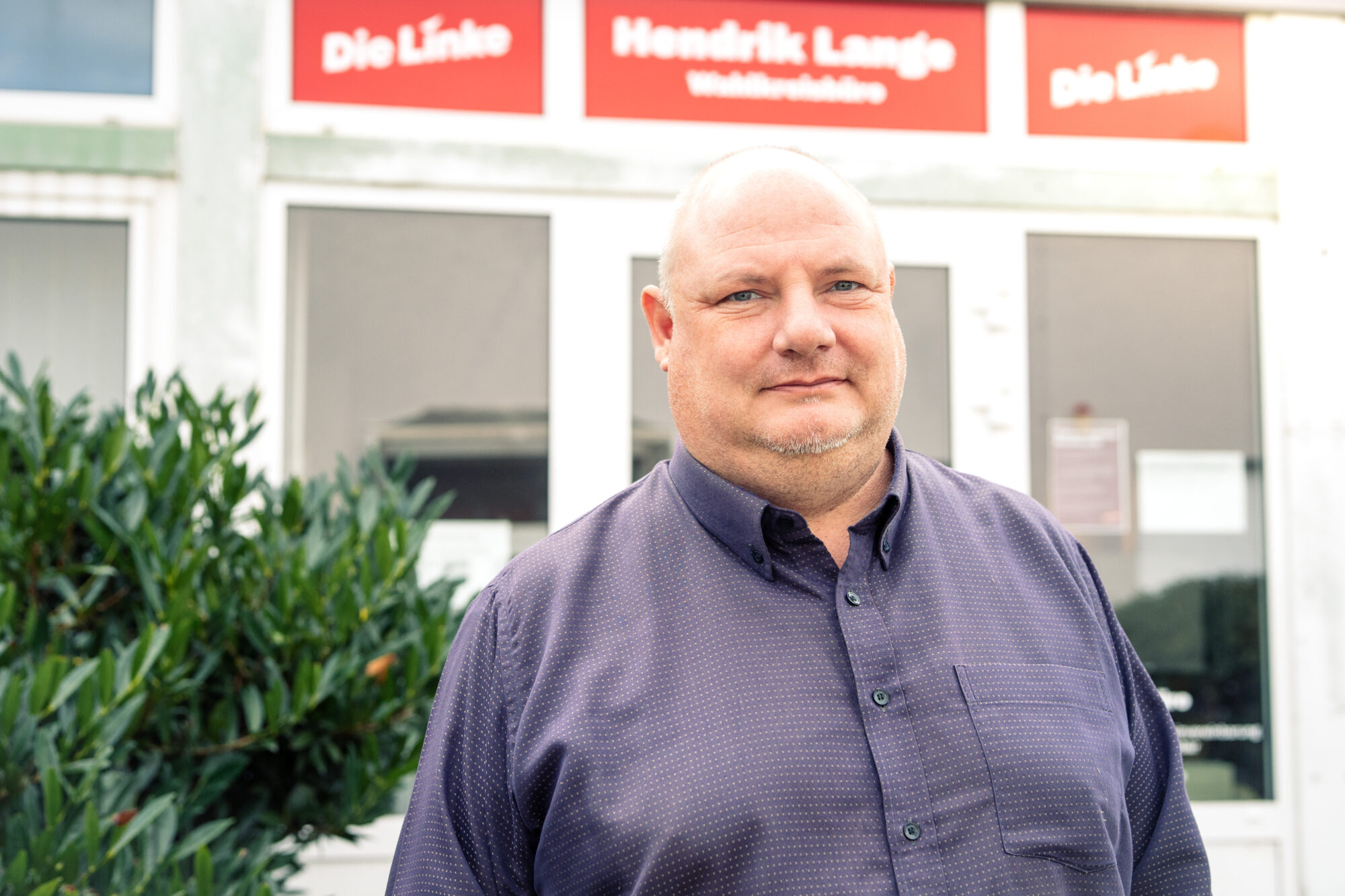
One person who wants to change this is Hendrik Lange, city councillor and state parliament member for Die Linke. We meet him for an interview in his Neustadt constituency office Am Gastronom. Lange also supports the city council’s resolution. In his opinion, school social work could be financed by unoccupied positions for teachers. Lange considers it negligent to rely on another funding period through EU ESF funds. This is because ESF funds are project-related and not intended for permanent tasks. And the state and municipalities are already required to participate in the financing of the program. 60 percent of the funds come from the EU, 30 percent is borne by the state, and 10 percent by the municipalities – although a fierce dispute between the state and municipalities preceded the distribution of costs.
According to Lange, a clear regulation in the state’s Child and Youth Welfare Act is also needed, as this is the only way to ensure that school social workers are not used for non-related tasks such as tutoring or substitute teaching. However, the state does not consider itself responsible. School social work is sufficiently regulated by law, and the reform of the Social Code Book does not oblige the state to create a further legal framework. The Child and Youth Welfare Act was last reformed in October, and school social work is expressly not included there, even though the state government agreed in the coalition agreement to make school social work permanent.
School social work is required by law
Jan Kepert, a professor at Kehl University of Applied Sciences and an expert in social law, vehemently contradicts the state’s view. The federal government deliberately refrained from detailed regulations in the Sozialgesetzbuch, expecting the states to make use of their legislative reservation. Funding guidelines and administrative regulations are insufficient, and the expiration of funding would be an obvious legal violation. However, the federal government cannot force the states to make a corresponding regulation in state law.
Nevertheless, school social work is a mandatory task that the municipalities must ensure. Although there is no individually enforceable right to school social work, the providers of independent youth welfare can at least insist on an error-free discretionary decision on their funding applications. “It would be a gross legal violation to reject the application because there is no money. Because there is supposed to be money,” says Kepert.
Metzner is optimistic that the financing will somehow continue and that no one will seriously jeopardise school social work. “No one is that stupid. That would be shooting oneself in the foot.” In particular, the police and youth welfare offices benefit from the preventive work that social workers do in schools. Who would want the situation to escalate?
If school social work is to be secured, something needs to happen now, says Lange. Because there are elections next year, and the late formation of the government shifts the adoption of the budget to 2027. And beyond that, the question is who will form the next government. The AfD would prefer to discontinue school social work. AfD state parliament member Hans-Thomas Tillschneider describes it as a “parasitic system” – rhetoric that ties in with the vocabulary of “old parties” and “lying media.” According to state election polls, the AfD stands at 40 percent; if several parties such as the SPD, Greens, FDP, or BSW fail to clear the 5 percent hurdle, an absolute majority government by the AfD would be conceivable. The AfD would not have to do anything to end school social work; letting the funding expire would be enough.
Janko, however, not only wishes for long-term financing and more positions from politicians but also a reduction in bureaucracy. A large part of her time is taken up by applying for support services, which are used to pay for sports courses, class trips, or tutoring. If parents are missing important documents, the process stalls, and notices are issued too late. But neither the parents nor the tutoring providers advance the costs. This is at the expense of the children’s educational opportunities. Lump-sum amounts per child and school year would be more appropriate, Janko believes.
Furthermore, school social workers whose positions are financed by ESF funds are obliged to document their activities minutely: How many students, parents, or teachers did they speak to – what part of that was preventive or interventionary? How many individual cases do they supervise? But the success of the work cannot be measured by numbers alone, Janko finds – the quality of the relationship work is what matters. In addition, she has to develop a concept for the financing of her position for every funding period, as does her colleague at the school. However, this is done separately. Because the colleague is employed by a different organisation. One school, two concepts.
If Janko manages to complete two or three items on her to-do list by the end of the day, she can count herself lucky. The only constant is the final documentation of her daily work – for the monthly factual report, of course.