

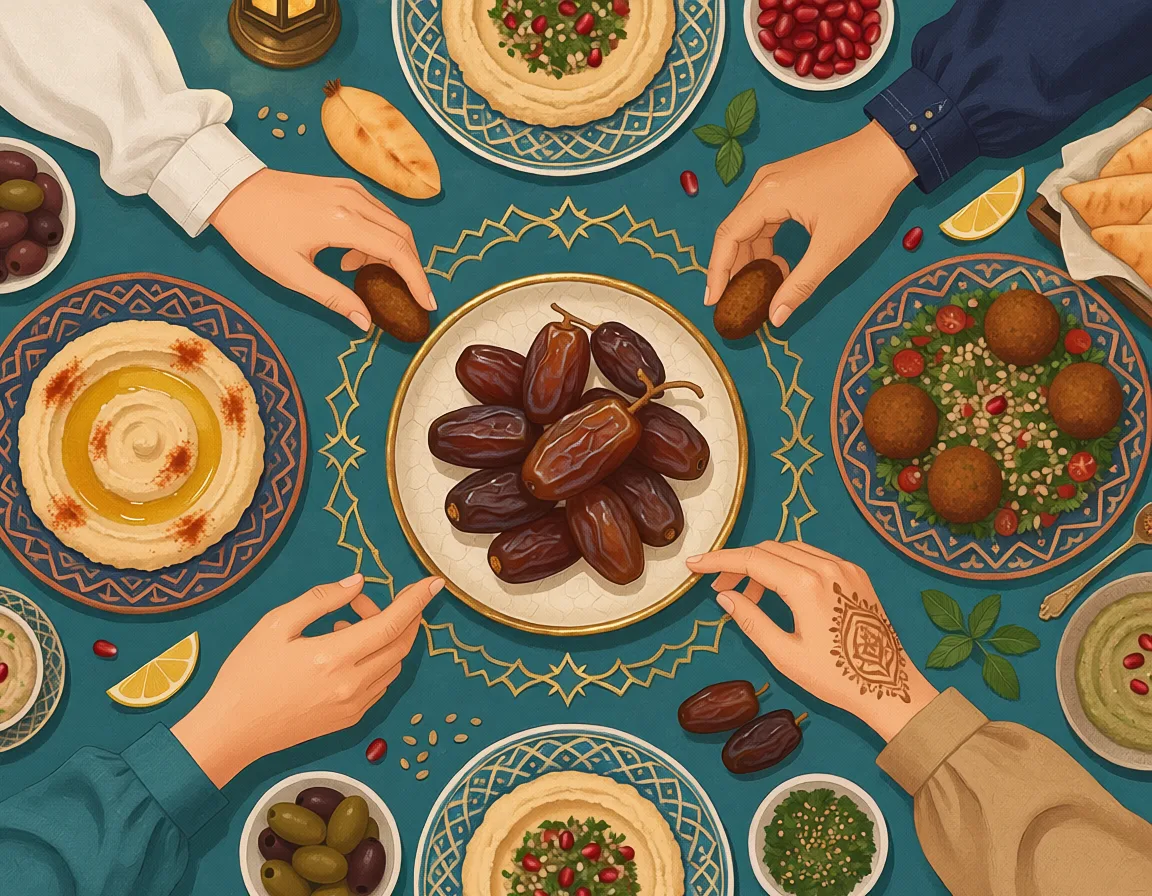
Our neighborhood reporter Dagmar got to know the culinary side of Islam during Ramadan and immersed herself in the tradition of breaking the fast. Here is what she learned about herself and her Muslim neighbors and friends.
“We’re taking a break,” my students Fatma and Hüsniye told me in early February after my weekly German class. A break—to find peace, to pause, to breathe. Over the coming four weeks, my students wanted to dedicate themselves to Ramadan: a time of reflection and gratitude, intended to cleanse both body and soul. Of course, I agreed to the time off. At the same time, I became curious and wanted to learn more.
I was raised in the Christian faith and only knew of Ramadan through stories, mainly as a time of abstaining from food and drink. But isn’t it also a time of prayer, gratitude, and trust in God? I wondered when I last prayed. It has been a long time. I wanted to try and put myself into that feeling.
My friend Aysegül advised me over the phone to “make everything softer” during Ramadan and not to do several things at once: to be slower, more mindful, and calmer in words and deeds. I tried to follow her advice. I took daily breaks from the routine and consciously spent moments in absolute silence, focusing on beautiful thoughts and feeling gratitude in that seclusion.
“Feel at home”
I began to enjoy these periods of inner peace more and more; at the same time, I looked forward to an invitation to Iftar, the communal evening breaking of the fast. Adel, a good friend from Syria, invited me to his home. He wanted to cook for me. I was to be at his place half an hour before sunset. I was a little nervous; it was my first time visiting him. When he opened the door, he greeted me with a slight bow, his hand placed over his heart. I could feel his joy in welcoming me. I slipped into my slippers.
We talked, but Adel’s gaze kept returning to his phone. He checked the time longingly. Then, the moment arrived: sunset. We took our seats at the kitchen table. Adel had prepared an oven dish of potatoes, onions, and chicken. The scent of cumin and cardamom filled the air. We placed everything in the center and ate with our hands. I used the warm flatbread to literally soak up the food. Adel repeatedly emphasized: “Feel at home.” How could I not? For dessert, we made ourselves comfortable on the sofa, and Adel served tea and a treat: rice pudding with orange blossom aroma. Delicious! He also tried my cookies, which I had baked following a Syrian recipe. Adel was stunned: “These taste exactly like the ones my grandmother used to make. You could open a café here.” We both laughed and, in that moment, felt like a small family.
Adel stepped away for a moment for his prayer of thanks. Afterward, he told me about his childhood in Syria. To him, breaking the fast always means sharing: empathizing with those who have less and with the poor and suffering. After more than ten years of civil war, there are more of them today than ever. We said our goodbyes early. Adel had to get up early because he wanted to have a hearty breakfast before sunrise to stay strong for the coming day: oatmeal, fruit, a protein shake, and plenty of tea and water for the long day ahead. Between sunrise and sunset, he would neither eat nor drink.
On my walk home, I encountered many people, some carrying plates and bowls. Surely, they were also coming from an Iftar meal with friends. Almost everyone wished me a pleasant evening as they passed, even though we didn’t know each other. But after the hours spent at Adel’s, I felt a special sense of familiarity toward them, too.
A shared table often connects more than words
My second Iftar invitation took me to the Protestant Paulus congregation. The “Horizonte” initiative had invited people to break the fast. It is a group of people from Turkey who regularly offer events where interested people from different religions can get to know one another. Here, I ran into Fatma from my German course again. It was a large hall with tables set for a hundred guests. There was a bustling atmosphere, almost like a bazaar: families bringing bowls and pots for the buffet, conversations, laughter, children jumping around—a boisterous mood. Then the call to prayer sounded. Iftar could begin. I took a seat among Fatma’s relatives.
Fatma bustled between the kitchen and the buffet, making sure everyone was well taken care of. The dishes enchanted me with their oriental scents and were lovingly arranged. Traditionally, dates and water are served first to provide the body with energy and hydration. Fatma’s niece, Elif, enjoyed a small piece of a sweet date, biting into it slowly. It was a gift for her. Only the first week of fasting is a challenge, she told me. After that, the stomach shrinks, and she doesn’t feel that much hunger anymore. But the first sip of water is always a blessing for her—especially when Ramadan falls during the hot summer. Then, she feels immense gratitude for every sip.
To conclude the breaking of the fast, guests are compensated with what is known as “Zahnmiete” (tooth rent). I received a rose and a box of homemade cookies from the hosts as “reparation” for my teeth being worn down while eating. I was touched by the gesture and said goodbye with a warm hug to the kind-hearted people I had the chance to meet.
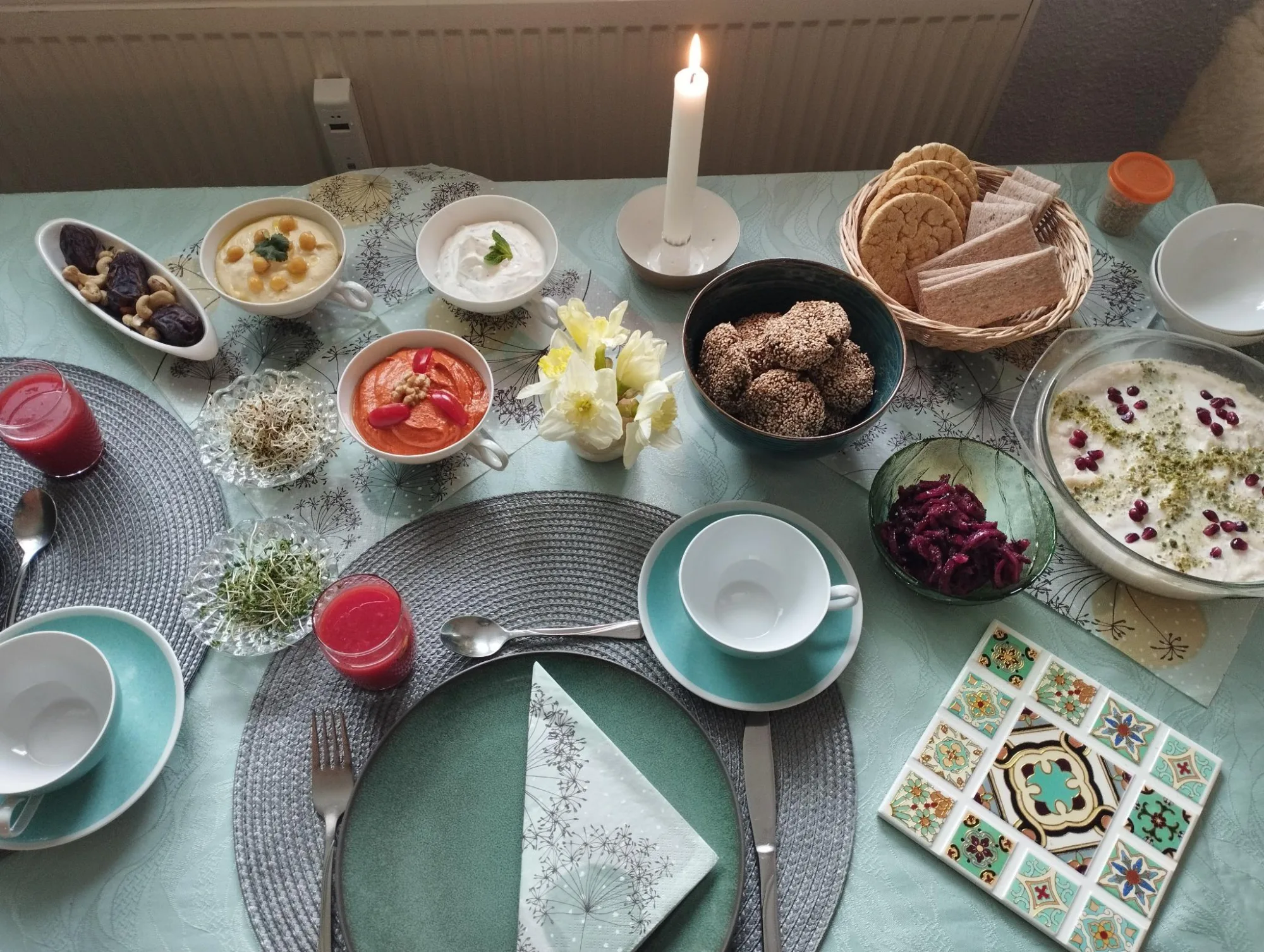
Almost everyone met again a few days later at the Halle-Neustadt stadium for the Ramadan festival, the crowning conclusion of the fasting month. This time, right at sunrise. Traditionally, this day and the subsequent Eid al-Fitr (Sugar Feast) are celebrated festively with family. I invited my Syrian friend Adel to breakfast. This way, I could return some of his hospitality and perhaps offer him a little piece of home. A shared table often connects more than many words can.