
I’ve been roaming the streets of Halle-Neustadt for over a year – not as a fugitive passer-by, but as a seeker who follows the forgotten stories behind the blue street signs.
My work started in the ‘Street QR project’, which at first glance appears purely technical: QR codes are generated and attached to lampposts to associate passers-by with the life stories of those personalities after whom the streets are named.
But this wandering quickly turned from a documentary task into a confrontation with the ‘silence of memory’ – and with its conspicuous vacancies.
As I programmed the digital codes, the names in front of me piled up a list that seemed like an exclusive ‘men’s club’. A precise evaluation produced a number that does not require any interpretation.
69 streets bear men’s names –
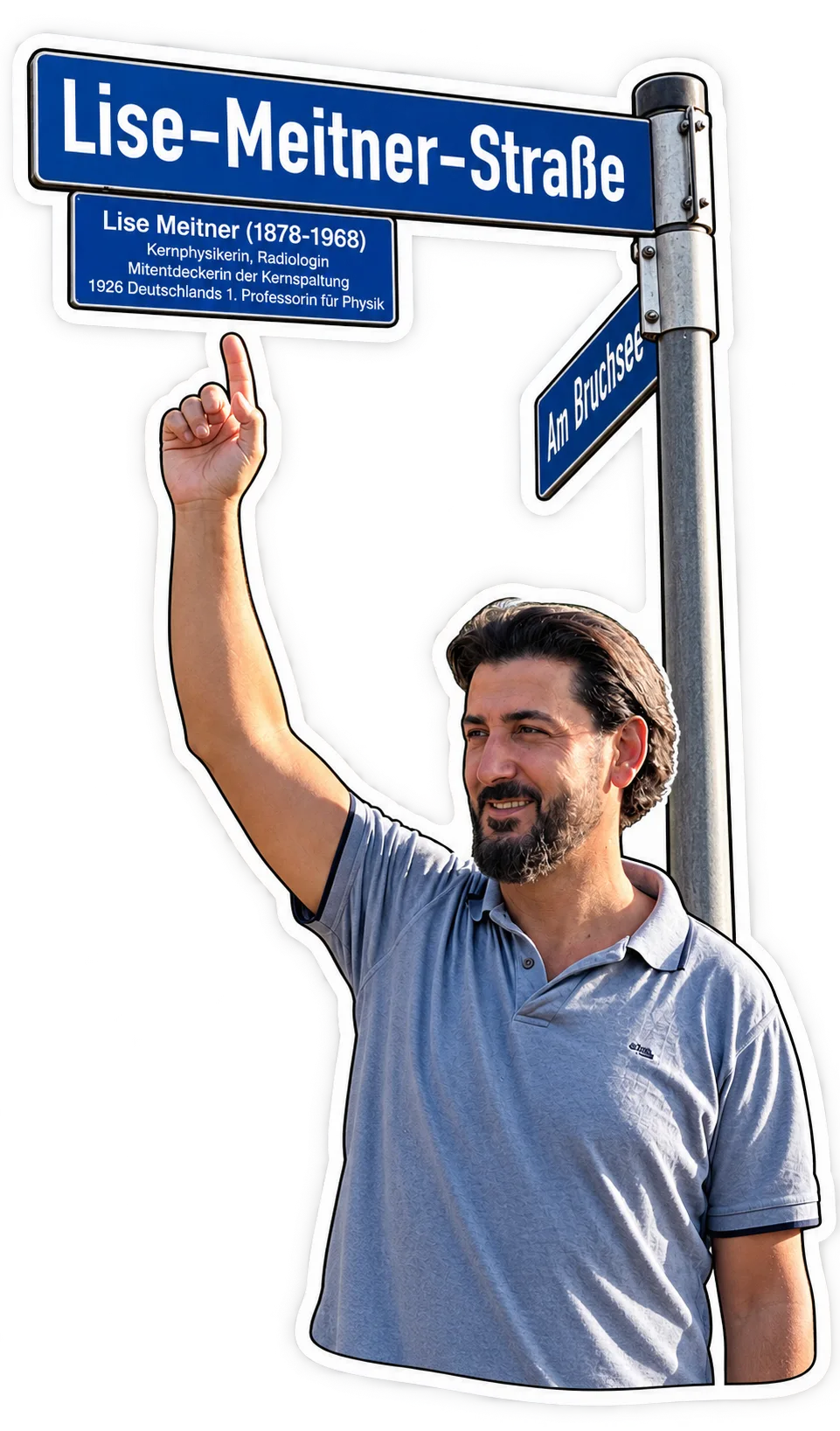
In contrast, there is only one street named after a woman: Lise-Meitner-Strasse. A woman stands alone in an entire district – as if she had been the only woman invited to this celebration of memory.
In a remarkable irony, one also discovers that there are 18 streets of plant names and seven with horse names in the district. 18 roads are named after waters – especially after rivers.
Plants, horses and bodies of water seem to be more present in urban memory than women who have had a significant impact on history, science and society.
a planned order – and a conspicuous void
However, this distribution did not arise by accident. Until the German reunification, there were no street names in Halle-Neustadt – apart from a few exceptions. Orientation was mainly via numbered residential complexes and blocks. Only after reunification did many streets get their current names.
If the names were chosen deliberately, who was found to be memorable within these topics – and who wasn’t?
The naming followed a recognizable concept: thematic focal points were developed for the individual residential complexes. Thus, the districts received the names of plants, horse breeds, rivers, composers, artists and scientists. The names should give the quarters their own character and at the same time make orientation easier.
However, this well thought-out system does not make the numbers any less remarkable, but raises another question: If the names were deliberately selected, who was found to be memorable within these topics – and who not?
Among the artists, composers and scientists whose names are on the street signs today, there are almost exclusively men. That doesn’t have to have been the result of a conscious decision against women. Rather, it refers to ideas about whose achievements at that time were of course considered memorable.
You don’t have to look far to find women who were directly involved in the emergence of Halle-Neustadt. One of them is Helga Gärtner. As a young civil engineer, she came to the newly founded office of the chief architect Richard Paulick at the end of May 1964 and worked there until the beginning of 1968. Together with architects, engineers, surveyors, draftsmen and other employees, she was part of that Planning work from which the new city emerged.
Today Helga Gärtner himself tells about this time And thus preserves a piece of city history that is hardly visible on the street signs. And her story is probably not alone. There were other women who were involved as engineers, architects, workers or in other professions in the construction and in the life of Halle-Neustadt.
Perhaps there are a few names that will earn a place in public space in the future, i.e. closer than we think: in the biographies of those women who helped build and shape Halle-Neustadt themselves.
The QR code: a window in the gaps
Through our ‘Street QR project’ I became aware that technology not only documented, but also made visible what was missing. Street names are more than mere points of reference – they form a visual narrative that passers-by, especially children, conveys who is considered to be memorable and who is not.
Every QR code we put on a lamppost today leads to a story. But the reality shows that the stories of women have hardly been told on these signs so far.
It’s not about repaying existing names, but about expanding memory – so that it represents a more realistic image of social diversity and sets fairer standards for whose names are immortalized in public space.
On the way to a more balanced culture of remembrance
Modern cities have the real chance of correcting this symbolic imbalance – not through extinction, but through supplementation.
For example, Lise-Meitner-Strasse could become a lively place of remembrance from a quiet geographical designation – for example through an annual event that honors the achievements of women in science, culture and city history. The stories of those women who were involved in the emergence and development of Halle-Neustadt could also be told.
Such a step would not only break the silence of the numbers. It could also help to make the still missing stories visible – and to turn the QR codes from bare windows into the past into tools for a more balanced collective memory.
StraßenQR ist ein Teilprojekt von „Unser HaNeu“ im Rahmen der Smart-City-Initiative der Stadt Halle (Saale). QR-Codes im öffentlichen Raum machen die Geschichten hinter den Straßennamen Halle-Neustadts digital zugänglich und verbinden so Stadtgeschichte mit den Orten des heutigen Alltags.